Free Download Autodesk Flame 2027 for MacOS Full Version – Latest Offline Installer – Advanced 3D visual effects software.
Overview of Autodesk Flame for macOS
If you’re in the world of high-end post-production, you know that “real-time” isn’t just a buzzword—it’s a survival requirement. Whether you’re working on a Super Bowl spot or a Netflix original, the pressure to iterate quickly with a client over your shoulder is intense. Enter Autodesk Flame 2027 for MacOS, the latest evolution of the industry’s most powerful “finishing” tool.
For 2027, Autodesk has leaned heavily into the M-series Apple Silicon architecture, turning the latest Mac Studios and MacBook Pros into portable VFX powerhouses. If you’ve been waiting for the right moment to migrate your workflow from Linux to Mac, or if you’re just looking to see what the new AI tools can do, you’re in the right place.
Quick Summary: What’s New in Flame 2027?
Autodesk Flame 2027 is an all-in-one suite for 3D compositing, VFX, and color grading. The 2027 release (launched April 2026) introduces ML-driven Depth Maps, enhanced Metadata preservation, and the Autodesk AI Assistant. It is natively optimized for Apple Silicon and requires macOS 13 or later.
The Verdict: It remains the gold standard for integrated finishing. While the $5,215/year price tag is steep, the speed at which it handles complex 3D scenes and HDR grading in a single environment is unmatched by cheaper alternatives.
Key Features: Why Flame 2027 Dominates the Finishing Suite
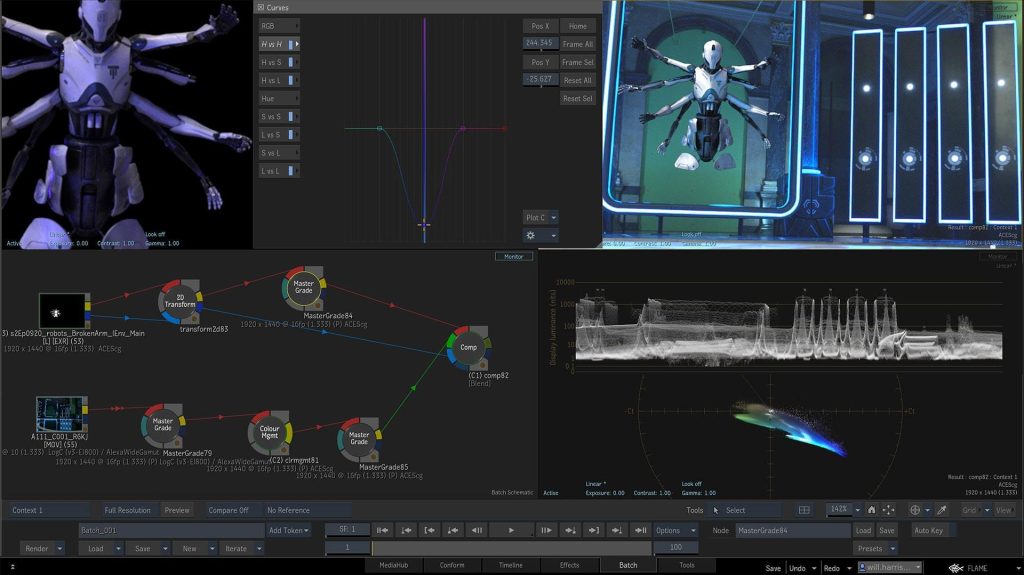
Flame has always been known for its “Action” environment—a 3D space where compositing feels as fast as 2D. In 2027, that speed is amplified by machine learning.
1. AI-Powered Image Segmentation
The 2027 update introduces two new machine learning models specifically for ML Depth. You can now generate high-quality depth maps from flat images to create realistic fog, z-depth blurs, or selective mattes without manual rotoscoping. The semantic keyers for human bodies, faces, and skies have also been refined for pixel-perfect isolation in seconds.
2. MasterGrade Color & HDR
Flame 2027 isn’t just for VFX; it’s a world-class color grading tool. The MasterGrade toolset is fully HDR-ready and float-point capable. It integrates seamlessly with professional colorist panels, allowing you to jump from a complex 3D composite to a final Dolby Vision grade without ever leaving the timeline.
3. Unified Timeline & Batch Workflow
One of Flame’s greatest strengths is that it doesn’t force you to choose between a timeline (like Premiere) and a node graph (like Nuke). You can edit your sequence on the timeline, pop into a “Batch” node group for a specific shot, and see the results instantly reflected in your edit.
Technical Requirements: Can Your Mac Handle Flame 2027?
To run Autodesk Flame 2027 for MacOS, you need a serious machine. While it can run on an Intel Mac, the experience on Apple Silicon is night and day.
| Component | Minimum Requirements | Recommended (Pro Workflow) |
| Operating System | macOS 13 (Ventura) | macOS 15+ (Sequoia) |
| Processor | Apple M-Series (M1/M2) | Apple M3 Ultra or higher |
| Memory (RAM) | 32 GB Unified | 96 GB Unified or higher |
| Storage | 20 GB for App / 1TB SSD | High-speed NVMe/Thunderbolt RAID |
| Graphics | Native Apple GPU | 60-Core GPU or higher |
Flame 2027 vs. The Competition
| Feature | Flame 2027 | Foundry Nuke | DaVinci Resolve |
| Best For | Commercial Finishing | Feature Film VFX | Color & Basic VFX |
| Workflow | Hybrid (Timeline + Node) | Pure Node-Based | Hybrid (Timeline + Node) |
| Real-Time Performance | Elite (Highest) | Moderate | High |
| Price | ~$5,215/year | ~$5,000+/year | Free / $299 Once |
| Learning Curve | Very Steep | Steep | Moderate |
Why choose Flame? If you are in a client-facing session where every second counts, Flame’s integrated environment is faster than round-tripping between Nuke and a separate editor.
Who Is This Software Best For?
- Commercial Finishers: If you’re doing high-end advertising, where the edit, VFX, and color happen simultaneously.
- Senior VFX Supervisors: Those who need to build 3D scenes, track cameras, and perform high-end beauty work in a single session.
- Boutique Post-Houses: Studios that want a “hero” seat that can handle a project from conception to final delivery.
Final Verdict
Autodesk Flame 2027 for MacOS isn’t for the faint of heart—or the faint of wallet. It’s a specialized tool for professionals who need the absolute best in integrated VFX and finishing. With the 2027 update’s focus on AI-assisted depth and metadata preservation, it’s clear that Autodesk is committed to making the “M-series Mac” the ultimate home for Flame.
If you’re a pro looking to cut down on render times and stay in the creative flow, this is the version you’ve been waiting for.
Frequently Asked Questions (FAQs)
Is Flame 2027 native on Apple Silicon?
Yes! Flame 2027 is fully optimized for M1, M2, and M3 chips. It leverages the Neural Engine for its AI tools and Unified Memory for incredibly fast playback of uncompressed media.
What happened to the Linux version of Flame?
It’s still very much alive. Flame 2027 runs on Rocky Linux 9.3 and 9.5. While the Mac version is great for many, the Linux version still offers higher scalability for massive multi-GPU setups.
Can I try Flame 2027 for free?
Autodesk offers a 30-day free trial. It’s the full version of the software, so you can test it on your specific hardware before committing to the $5k+ annual fee.
Does Flame 2027 support macOS 12 (Monterey)?
No. Starting with the 2027 release, the minimum requirement has been bumped to macOS 13 (Ventura). If you are still on an older OS, you will need to stick with Flame 2025 or 2026.
What is the difference between Flame and Flare?
Flame is the full “all-in-one” suite. Flare is a “Batch-only” version of Flame. It doesn’t have the timeline or finishing tools, but it’s perfect for VFX assistants to handle rotoscoping and compositing shots that are then sent back to the main Flame suite.
Do I need a Wacom tablet for Flame?
While you can use a mouse, a Wacom Intuos Pro is considered the industry standard for Flame. The software’s gesture-based UI was literally designed for pen input.